

The Strategic Art of Prompting
The use of ChatGPT and other artificial intelligences (AI) in philosophy can be manifold and offers interesting possibilities, particularly with respect to the reading of texts and support for examination performances. In this regard, it is advisable, on the one hand, to upload the texts and materials one is working with as text files. On the other hand, one should provide the methodological and systematic framework of one's discipline as a conceptual and semantic framework. One may tell the AI from which perspective it ought to think. (Guidance on this may be found, on the one hand, in my reflections on finding philosophical questions, and, on the other hand, on the glossary page of my introduction to ethics.)
The University of Münster provides, with gpt.uni-muenster.de, a platform of various AIs, which, however, can compete with commercial external offerings only to a limited degree, since they have no "connection to the outside world" (at least thus far). AIs will also revolutionise literature research. The ULB Münster provides scopus.AI from Elsevier (test access as of 05.25). For this, you must be within the IP network of the UM (that is, activate VPN).
A better offering is accessible to students within the German Research Network (DFN): https://academiccloud.de/de/services/. The academiccloud lists, in addition to the AI chatbot "Chat-AI", a number of further offerings. The login functions via "Federated Login" (select Uni-Münster and then log in with your standard university account). Among the selectable models, "Sauerkraut" is oriented towards scholarly use. Extremely useful is arcana within the academiccloud environment (information may be found here). Arcana enables you, within the AI chat, to draw upon a reserve collection as support for your conversation. Thus, you may, for instance, upload your materials for a lecture or seminar (scripts, source texts, articles, your notes, …) into arcana. In the chat, you then converse with these texts as background knowledge.
Commercial offerings are — as already mentioned — chatGPT, perplexity.ai.
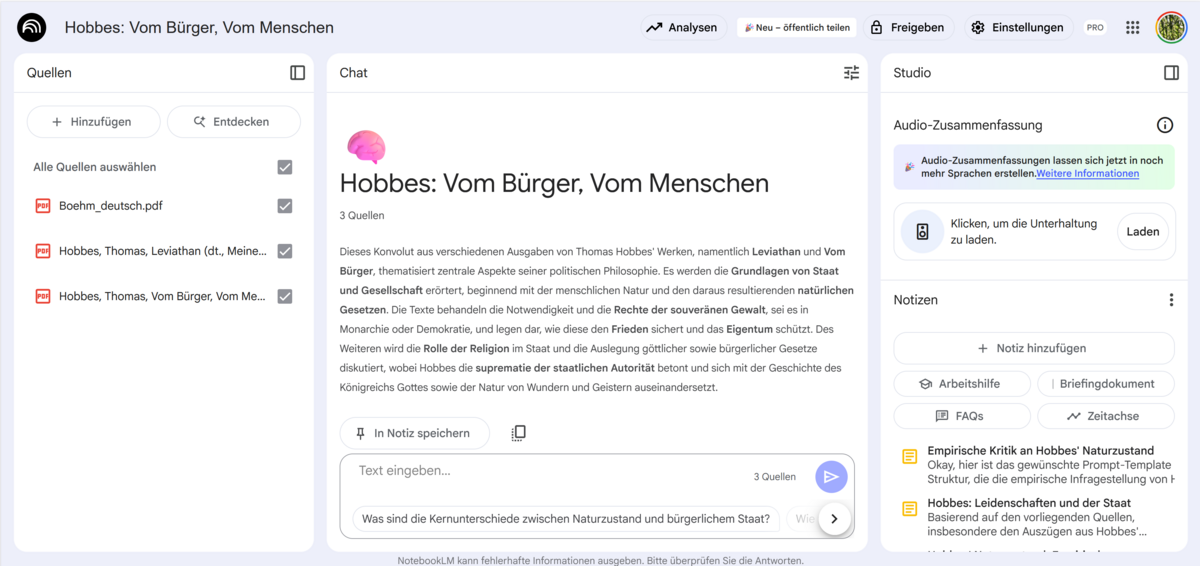
A kind of desk with reference materials, into which the books and other materials for projects, seminars, lectures, … can be uploaded, is: notebooklm.google. This tool is exceedingly useful for use directly in seminar sessions as well. The areas of this desktop tool are: Sources (here one can enter seminar materials), Chat (here communication with the AI takes place), Studio (here further functions are available: for instance, creating a podcast), Notes (here results from the chat can be saved and subsequently made available as a source in the Sources area).
There is, however, an unmanageable abundance of offerings that are constantly changing in their capability and relevance for one's studies.
One should also bear in mind that engaging in disciplinary discourse with AIs must be practised. And whoever expects that all answers will be granted through a single question will receive "42". One should also, at some point, ask what questions one might pose as a philosopher (above all: which 42 questions). AIs help, but they do not spare one the work. Here are some methodically reflected possibilities for their use:
Engaging with Texts
Summaries: AI can break down long philosophical texts into concise summaries in order to support students or researchers in working out the central arguments. The following lists gather many direct individual prompts. You should note, however, that the true art of prompting lies in meta-prompts: generate prompts with prompts. And do so in several "foldings" – fold your prompts as in laminating puff pastry. Examples of graduated prompting can be found here: [1], [2], [3].
Example prompts are:
- "Summarise the following text in one paragraph, highlighting the main thesis, the most important arguments, and the author's conclusion: [insert text]."
- "Create a systematic outline of the following philosophical text. Show the central thesis, the main arguments, and the justifications for these arguments in logical order: [insert text]."
- "Summarise the text with regard to the question of how it fits into the systematic context of [e.g. utilitarianism, existentialism]. Which central concepts and arguments are emphasised?"
- "Compare the argumentative structure of the following text with that of [philosopher or work]. Where are there agreements and differences?"
- "Summarise the text by placing emphasis on the definition and function of the concepts [e.g. 'being', 'freedom', 'autonomy']. How are they developed and incorporated into the argumentation?"
- "Create a summary of the text and identify potential weaknesses in the argumentation. Which premises might be called into question?"
- "Summarise the text from the perspective of how the author conceives the relationship between [e.g. individual and society, mind and matter, ethics and politics]."
- "Summarise the text by showing how it relates to earlier positions (e.g. Aristotle, Kant, Heidegger). What connections or distinctions are drawn?"
- "Summarise the argumentative structure of the text. Which premises are stated, which conclusions are drawn, and which argumentative strategy is used (e.g. deductive, inductive, analogical)?
- "Create a summary of the text, differentiating between explicit statements, implicit assumptions, and possible interpretations."
- "Summarise the text in such a way as to create a foundation for further reflection on it in a seminar. What follow-up questions or problem areas can be derived from the author's arguments?"
- Summarise the section on the table of categories in the 'Critique of Pure Reason'. Address the systematic role of the categories in the process of cognition."
- "Create a concise summary of the chapter 'The Question of the Meaning of Being' in 'Being and Time' and set out how Heidegger develops the ontological difference."
- "Summarise the section on 'The Vita Activa' from 'The Human Condition' and explain the three fundamental human activities (labour, work, action)."
Explanations of Concepts
For complex concepts (e.g. "ontological difference"), ChatGPT can provide definitions or context-dependent explanations.
- "Explain the concept of 'ontological difference' in simple terms and describe what role it plays in Heidegger's philosophy."
- "Define the concept of 'dialectical materialism' and explain its significance in the context of the philosophy of Marx and Engels."
- "Explain the concept of 'transcendental' and its development from Kant to Husserl. How does its meaning change in different philosophical contexts?"
- "Describe the concept of 'freedom of the will' and set out how it is understood in ancient philosophy (e.g. in Aristotle) and in modern philosophy (e.g. in Kant)."
- "Explain the concept of 'substance' in the context of Spinoza's philosophy. How does it differ from Descartes's concept of substance?"
- "What does Nietzsche understand by 'eternal recurrence', and how is this concept connected with his notion of 'amor fati'?"
- "Distinguish the concepts of 'lived body' [Leib] and 'body' [Körper] in phenomenology. How are they respectively employed by Merleau-Ponty and Plessner?"
- "Explain the difference between 'practical reason' and 'pure reason' in Kant."
- "Explain the concept of 'Dasein' as it is developed in §9 of Heidegger's 'Being and Time'. What fundamental characteristics of Dasein does Heidegger describe here?"
- "What does Hegel mean by 'sublation' [Aufhebung] in the 'Phenomenology of Spirit'? Refer to the section on 'lord and bondsman'."
- "How does Adorno define the concept of 'negative dialectics', and how does he distinguish it from classical dialectics?"
- "Explain the concept of 'ideology' in the context of Critical Theory. Which aspects do Adorno and Horkheimer emphasise in contrast to Marx?"
- "What does Aristotle understand by 'eudaimonia', and how is the concept systematically developed in the Nicomachean Ethics?"
- "How is the concept of 'domination' defined by Foucault in the context of the analytics of power, and how does it differ from traditional political theories?"
- "Explain the concept of 'state of nature' and describe how it is interpreted differently by Hobbes, Locke, and Rousseau. What criticism might be raised against it?"
- "What is the 'categorical imperative' in Kant, and what objections did Schopenhauer raise against this concept?"
- "Explain the concept of 'lifeworld' [Lebenswelt] in Husserl and set out how it was further developed in sociology (e.g. by Habermas)."
- "What does 'poststructuralism' mean in philosophy, and how does this concept distinguish itself from structuralist approaches?"
- "Describe the concept of the Gadamerian 'fusion of horizons' in the context of hermeneutic philosophy and explain how it is applied to the process of understanding."
These prompts aim not merely to explain concepts in isolation, but to illuminate them systematically, historically, contextually, and critically. They also encourage one to consider concepts within the field of tension between different discourses or theories.
Critical Questions
AI can generate questions that prompt one to interrogate the central assumptions of a text. If you provide ChatGPT with a text and a glossary of methodical and systematic concepts, you can have it generate targeted critical questions that penetrate deeply into the text and its central assumptions. Here are some example prompts that support this task with methodical precision:
- "Read the following text and pose 5 critical questions that interrogate the central assumptions and argumentative structures. Use the provided glossary to employ methodically precise concepts: [insert text]."
- "Based on the text and the glossary, create a list of questions aimed at possible contradictions or unspoken premises of the author."
- "Which premises of the author are necessary to support the conclusions in the text? Which of these might be called into question or require more precise justification?"
- "Identify the main arguments in the text and pose at least three questions that call into question the validity of the argumentative approach used."
- "Formulate questions that can be applied specifically to the concepts [e.g. 'ontological difference', 'transcendentality'] from the glossary in order to interrogate the text's central argumentation."
- "How could the concept [e.g. 'hermeneutics'] from the glossary be used to point out possible weaknesses or alternative readings of the text?"
- "What questions arise when the text's central assumption is compared with the concept [e.g. 'autonomy'] from the glossary? To what extent might different definitions lead to a different understanding?"
- "How could a critical engagement with the conceptual definitions in the glossary expand or problematise the theoretical framework of the text?"
- "Pose critical questions that analyse the text with regard to the historical development of the concept [e.g. 'subjectivity']. Are there contradictions in the text with earlier or competing conceptions of this term?"
- "Which assumptions about the concept [e.g. 'freedom'] might be called into question from a systematic perspective (e.g. in comparison with Kant or Hegel)?"
- "What interpretive latitude does the text leave with regard to the concept [e.g. 'lifeworld']? What critical questions arise from this when different meanings or contexts of the concept are taken into account?"
- "Pose questions that interrogate whether the definition of the concept [e.g. 'truth'] used in the text is consistent and methodically convincing.
- "What practical consequences follow from the assumptions in the text when the concept [e.g. 'power'] from the glossary is applied? Could these consequences be critically called into question?"
- "To what extent is the definition of [e.g. 'action'] in the text sufficient to explain concrete social or political phenomena?"
- "What unspoken assumptions about the concept [e.g. 'cognition'] are found in the text? Pose questions that expose and critically illuminate these implicit premises."
- "Identify possible blind spots in the text with