


The moral status of animals, living beings, and nature
What moral status do animals, plants, and inanimate nature possess? The concept of moral status is narrower than that of an ethics, yet it is not subsumed within it. The following sections develop a concept of moral status in eight theses and subsequently apply it to animals, other living beings, and nature.
Moral Status in Theses

1 Hindering Prejudices: Metaethics of Moral Status (Th 1)
A philosophical treatment of the question of moral status must, in principle, be capable of encompassing individuals, collectives and kinds of objects, animate and inanimate objects, as well as personal life. Many methods of justification in animal and bioethics, however, fail from the outset to grasp certain entities as morally relevant – an including or excluding prejudice that one ought, philosophically, to describe as de-addressing. De-addressing ought to be capable of being justified.
Th-1 · Prejudice (level of inclusion theory)
A philosophical treatment of the question of the moral status of any given entity must, in principle, be capable of encompassing individuals as well as collectives, as well as kinds of objects, but also animate objects, inanimate objects, and personal life.
1.1 Moral Status
The concept of moral status can never be conclusively clarified in philosophical terms: one approaches it either from a practical perspective (a), from a systematic one (b) – or one attempts a provisional definition (c). Neither of the first two perspectives is accorded any principled precedence.
Th-2 · Ontology (ontological level)
Only discrete entities can have a moral status.
Th-3 · Relevance (semantic level)
A moral status is constituted only by those properties that render a discrete entity morally considerable.
Th-4 · Ambivalence (level of knowledge and validity)
The discussion concerning the moral status of any given entities remains notoriously undecided between an epistemological meaning of the relevance of these entities (moral relevance arising from persons' immediate response to entities) and a theoretical meaning thereof (moral relevance as a normative reconstruction within ethics).
Why this intermediate reflection? The question of status is borrowed from the juridical context (legal capacity, dignity).
An intermediate reflection on juridical status (legal capacity, human dignity) reveals: even within the law, questions of status are deliberately constructed as open, unclear, and variable. The thesis of ambivalence thus pertains not only to moral, but also to juridical status.
Th-5 · Duality (ontological level)
The moral relevance of an entity may depend on intrinsic or extrinsic properties, such that a moral status may be direct or indirect, that is, immediate or derived.
1.2 Moral Status within the Framework of Ethical Justification
From a practical perspective, the concept remains notoriously unclear (Th-4); everything that is not direct can be indirectly incorporated by way of extrinsic properties (Th-5). The radical counter-position – contractualism admits status only as derived – provokes a characteristic counter-reaction:
Th-6 · Preference (level of knowledge and validity)
Whoever makes moral status the subject of argument in debates tends toward three theoretical preferences: (i) to regard morally relevant entities as discrete and ontologically "robust", (ii) to conceive moral relevance as direct, and (iii) to orient oneself more toward intrinsic than toward extrinsic properties.
1.3 Moral Status as a Practical Criterion
Th-7.1 · Validity (complexity of the level of validity)
Differentiated concepts of moral claims to validity are compatible with the concept of moral status insofar as there exist degrees of the considerability of that which is to be considered.
Th-7.2 · Validity (value structure of the level of validity)
Differentiated concepts of moral claims to validity are compatible with the concept of moral status insofar as its valence is multi-layered and diverse.
Th-8 · Neutrality (practical level)
That something is morally considerable need not mean that this already implies unambiguous rules of conduct as to its content.
The simple image "Look, here is animal suffering!" does not, without further ado, lead to the imperative "Avoid this animal suffering!" – the transition from value to obligation requires bridging principles.
Why the theses must not remain mere assertions
A thesis that is cited without its derivation changes its logical genus: a result becomes a stipulation. In the case of these eight (or nine) theses, this has particularly significant consequences for three reasons.
First, they would fall under their own verdict. Th-1 criticises methods of justification that exclude certain entities before the examination has even begun. An underived thesis does precisely this in propositional form: it fixes a domain of investigation without disclosing the path along which it arose. The prejudice thesis thus first commits the text to itself — it would be performatively refuted the moment it were merely asserted.
Second, they are predominantly negative theses. "Only discrete entities …", "notoriously undecided", "need not mean" — the content of these sentences is not information about how matters stand, but the record of what could not be clarified. They are residues of three paths that are traversed in the following reflections and successively shown to be inadequate (the practical, the systematic, the provisional option). Without the aporia from which they stem, scepticism reads like dogmatism: Th-2 would sound like an ontology it is not; Th-4 like a resignation it is not.
Third, the mere statement repeats the very gesture that Th-7 and Th-8 criticise. To merely point at suffering is, according to Th-8, not a justification but — in Kantian diction — idolisation; animal ethics presents moral status "as in a monstrance" and calls for veneration. A list of theses on a web page is formally the same gesture, only one level of reflection higher: something important is displayed and offered up for assent. The medium favours this error, since lists suggest authority where arguments ought to stand.
There is, moreover, a practical point. Only the derivation renders the theses open to criticism: an assertion can only be accepted or rejected as a whole; a derived thesis reveals at which point — at which example, at which transition — objection may take hold. And only the derivation reveals their scope: that Th-2 formulates a necessary, not a sufficient, condition; that Th-6 is meant diagnostically, not normatively; that the definition expressly remains a provisional attempt. Whoever reads the sentences in isolation makes them harder than they are discussed here.
Th-1 · Prejudice Thesis
A philosophical treatment of the question of the moral status of any given entity must in principle be able to encompass individuals as well as collectives, as well as kinds of objects, but also animate, inanimate objects, and personal life.
Derivation. The thesis arises from an observation concerning the method of many animal and bioethical theories: they choose modes of justification that cannot capture certain entities as morally relevant from the outset. Whoever says, for instance: "Suffering — and only suffering — confers moral status" has thereby excluded species and ecosystems from the investigation before the investigation has even begun. For species and ecosystems do not suffer.
For the question of moral status to be posed as an open question at all, the domain of objects must first be conceived as broadly as possible — hence the deliberately presupposition-poor technical term "entity": everything that can be philosophically reflected upon, from the individual animal to the species to the ecosystem.
The designation "prejudice thesis" thereby points in two directions: it names, first, the delimiting prejudices of common sense (what appears to us in everyday life as worthy of consideration is not thereby already worthy of consideration) and, second, the excluding prejudices of an ethical theory (what a theory excludes is not thereby already excluded). Both forms of prejudice must be weighed against one another as the inquiry proceeds — the thesis commits the investigation to privileging neither of the two in advance.
[Interpretation] Th-1 is thus not a substantive claim about status, but a methodological opening clause: it secures the domain of investigation before the levels (ontology, semantics, knowledge, validity) are traversed.
Th-2 · Ontology Thesis
Only discrete entities can have a moral status.
Derivation. The thesis results from the practical option: when we ascribe a moral status to an entity X in everyday life, we tacitly presuppose that it makes sense to speak of X. This requires two things: criteria of identity (what X is — ontology, semantics) and criteria of identification (how we recognise X). X must therefore be a discrete individual thing (Lat. discernere = to separate, to divide): standing on its own, delimitable from everything else.
It is precisely on this point that prima facie candidates such as "the universe" or "ecosystems" fail: ecosystems are contingent in terms of the Earth's history and can scarcely be delimited from their surroundings — on Earth, everything is connected with everything else. The Gaia hypothesis (Margulis/Lovelock) is instructive here: it conceptually turns life on Earth into one comprehensive organism, delimitable outwardly (the cosmos) and inwardly (inanimate matter). One may find this fanciful — but the hypothesis exemplifies the ontological strategy that every ascription of status must pursue: whoever wishes to grant the Earth as a whole a moral status must first construct it as a discrete entity.
[Interpretation] Th-2 thus formulates a necessary, not a sufficient, condition: discreteness is the ontological ticket of admission to the question of status — it decides nothing yet about whether a status is due to the entity.
Th-3 · Relevance Thesis
A moral status is constituted only by such properties as make a discrete entity worthy of moral consideration.
Derivation. Discrete entities possess countless properties — but not every one confers moral status. That something weighs 500 grams (an embryo, an African violet, a stone) is normally irrelevant to its status. From the set of all properties (a, b, c, …), the status-conferring ones (m₁, m₂, m₃, …) must therefore be filtered out. Promising candidates already named include: sentience, capacity for will, and being alive.
The real point of the thesis lies in the follow-up question: how does one find out which properties are relevant? There are two paths whose relation is problematic. Epistemologically: the mere fact that we factually accord an entity moral consideration can be an indication of a status. Conceptually: within an ethical theory, the relevant properties can be theoretically isolated. Both paths can diverge — a person-based ethics may conceive of the capacity for suffering as irrelevant, while valuing subjects factually treat it as relevant. The first path is not infallible, the second is capricious.
[Interpretation] Th-3 thus shifts the question of status from ontology to the semantic level: not that an entity has properties, but which of them count as "consideration-conferring" — and who determines this, and by what right — becomes the real problem.
Th-4 · Ambivalence Thesis
The discussion of the moral status of any given entities remains notoriously undecided between an epistemological (moral relevance arising from the immediate reaction of persons to entities) and a theoretical (moral relevance as normative reconstruction within ethics) meaning of the relevance of these entities.
Derivation. The thesis generalises the result of Th-3: "worthy of consideration" has both a factual and a normative meaning, and this ambiguity is irreducible — it cannot be resolved within actual contexts of argumentation. The example of the embryo makes this tangible: the fusion of egg and sperm cell is regarded by many as a "moral fact" at which one need only point. One may "feel" this demand — yet it may prove to be nonsensical (Kant speaks critically of "idolisation"). Conversely, no ethical theory can simply define away the status of the embryo merely because it considers itself the better theory.
An intermediate reflection supports the thesis from outside: the question of status is borrowed from juridical thought. There, precise instruments of status exist (majority/legal age: clear operational facts, clear consequences) — but also deliberately open ones (human dignity: unclear operational facts, few concrete consequences; the death penalty and abortion regulations show that killing and dignity can be reconciled legally). If even the law keeps questions of status open, unclear, and variable — among other reasons because of the plurality of underlying value conceptions — then this ambivalence applies all the more to moral status.
Consequence: The argumentative force of an appeal to status is limited. Neither does the sole appeal to personal rationality justify animal experimentation in general, nor does it forbid our immediate outrage at animal suffering in general.
Th-5 · Duality Thesis
The moral relevance of an entity may depend on intrinsic or extrinsic properties, such that a moral status can be direct or indirect, that is, immediate or derived.
Derivation. To the ambivalences of Th-4 is added a further one: status-conferring properties can be intrinsic (belonging to the entity itself in its discreteness, e.g. rationality or sentience) or extrinsic (arising from a relation). The standard example: even a strict person-based ethics can render animals or stones worthy of consideration — provided they are the property of a person. Their relevance is then derived from the status of the person.
The text shows that these distinctions become entangled in everyday life: the pet/livestock boundary (a ban on slaughtering dogs and cats, but not pigs) is a culturally contingent, extrinsic differentiation that precisely does not coincide with the intrinsic capacity for suffering — livestock animals suffer just as pets do. And the ethics of compassion demonstrates that "direct" need not mean "intrinsic": our compassion is an immediate reflex response to animal suffering (direct relevance), yet the value principle lies in our own suffering at the animal's suffering (extrinsic grounding). The example of wild animals, finally, adds the axis of immediate/mediate: we feel compassion for suffering wild animals, yet mostly do not help them — our compassion instructs in a generalised, not an immediate, way.
[Interpretation] Th-5 thus unfolds a panorama of four axes of distinction (direct/indirect, intrinsic/extrinsic, immediate/mediate, underived/derived). The critical point: very few animal ethics respect this diversity.
Th-6 · Preference Thesis
Whoever makes moral status an argument in debates tends toward three theoretical preferences: (i) to regard morally relevant entities as discrete and ontologically "robust", (ii) to conceive moral relevance as direct, and (iii) to orient oneself more toward intrinsic than toward extrinsic properties.
Derivation.
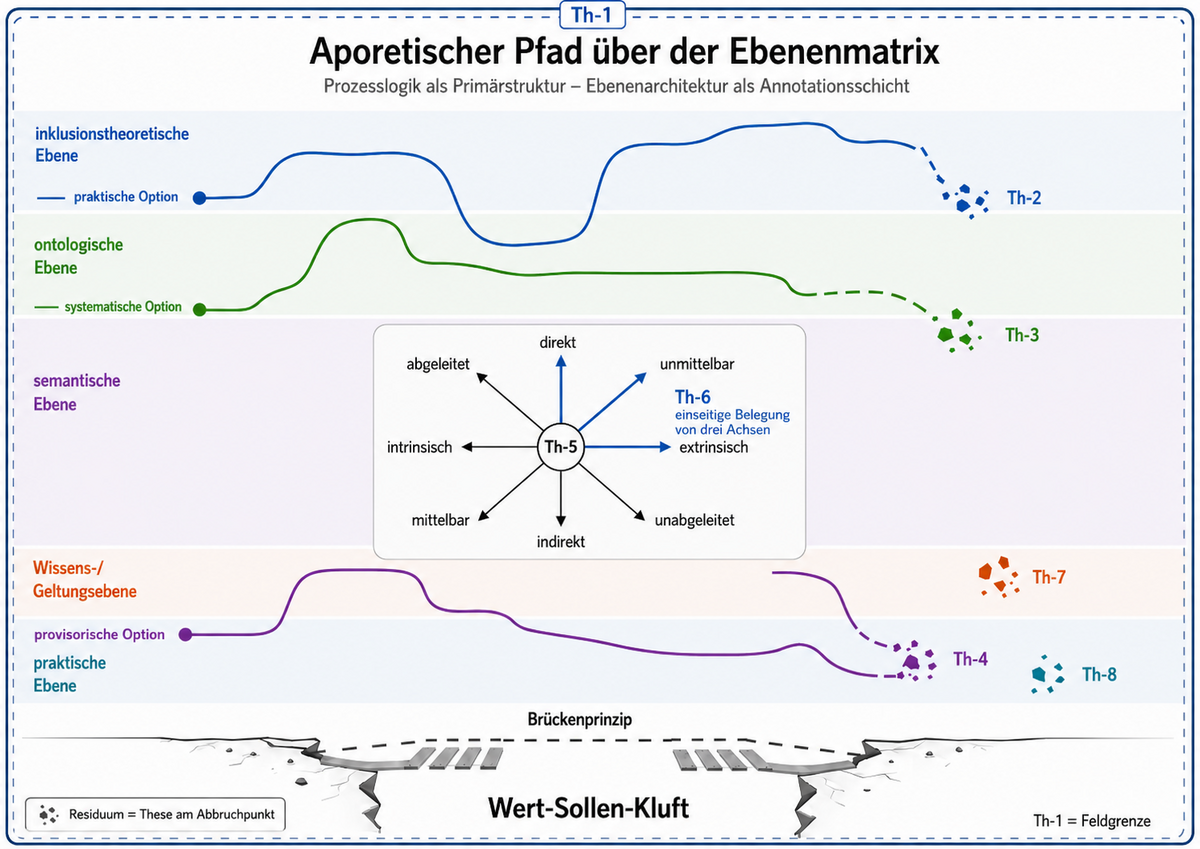
2 Open Definition of the Concept of a Moral Status
An animal-ethical definition of moral status can achieve no more than naming the points at which ethical theories actually diverge. It is then not a result of the discussion, but its ordered precondition. The following definition can only be closed within the framework of considerations of animal morality (or physiocentric considerations).
Definitional schema. An entity X has, in a respect H, a moral status in the validity mode G if and only if X possesses properties m₁ … mₙ that are identified, within the framework of an ethics, as status-conferring, and if from this follows a state-ought that renders X subject to a duty of consideration in moral deliberation.
This definition is open in four respects:
(i) List of properties: m₁ … mₙ is not closed (Th‑1, Th‑6).
(ii) Ontology of the bearer: X may be discrete or collective (Th‑2, Th‑5).
(iii) Validity mode: absolute, categorical, or contingent; weighable or not (Th‑7, Th‑7.1).
(iv) Relevance for action: the transition from the state-ought to the action-ought is not co-defined (Th‑8).
What remains open is the assignment of parameters, not the schema itself. An assignment that admits any property whatsoever as status-conferring abolishes the very distinction for the sake of which the concept of status was introduced; it is no longer an assignment, but its refusal.
Every closure purchases determinacy at a cost. Whoever fixes (ii) to discrete individuals must present the exclusion of species and ecosystems as a methodological exclusion; whoever opens (ii) to collective bearers must name the bearer of the good in question; whoever sets (iii) as thoroughly weighable must explain in what the violation of a status that is fully overridable still consists. The three assignments are presented below, each together with the burden it thereby assumes.
The three partially closed assignments of the basic definition:
Def‑P (pathocentric). m = sentience; X = discrete individuals; G typically categorical. – Burden of justification: species, populations, and ecosystems have only derivative status; the exclusion must be presented as a methodological exclusion, not as a finding (Th‑1).
Def‑U (utilitarian weighing of interests). Status is split in two: as a threshold concept (whoever has interests, counts) and as a weight (what counts is the interest). G = thoroughly weighable. – Burden of justification: It must be decided whether "interest" is conceived subjectively (preference) or objectively (condition of flourishing); in the latter case, Def‑U tips over into biocentrism. And: a status that is fully overridable is a status whose violation can no longer be described.
Def‑Ph (physiocentric, inclusive of biodiversity). m includes properties of order, integrity, and continued existence; X may be collective (species, population, biotope); G graded, topographical rather than tiered. – Burden of justification: whoever ascribes status to a species must specify the bearer of the good; otherwise "biodiversity" remains an interest without a subject. By the principle of parsimony, weak physiocentrism is to be preferred.
All three steps – the open schema, the partially closed assignments, and the possibility of a complete closure – are operations upon the concept, not upon practice. From none of them does it follow what anyone ought to do. This is not a reticence born of caution, but a consequence of the construction itself: parameter (iv) is not co-closed by the closure of (i) through (iii). Whoever has determined which properties confer status, which bearers come into question, and in which mode the status holds, has thereby determined a state-ought – that X is to be taken into account in deliberations. He has thereby not yet told any agent in what relation to X, under what alternatives, and by what means he is to comply with this obligation of consideration.
It is precisely the completeness of a closure that heightens the temptation to skip this step. A closed assignment looks like a result, and results seem to demand consequences. This is how the pattern arises that Th‑8 wards off: from the capacity for suffering of farm animals, a duty of vegetarianism is immediately inferred; from the status of species, immediately a duty of protection. In both cases, a gap in the premises is bridged by the emphasis of the result. The extent of the outrage thereby generated is no evidence for the validity of the inference.
What is missing is not little. An action-ought presupposes that it be stated in what relations the agent stands to X, what alternatives for action are open to him, how competencies are institutionally distributed, and what consequences his action actually has under given conditions. These premises are for the most part empirical and institutional; animal ethics can examine them, but cannot generate them out of itself. Added to this is the fact that the conflicts between the assignments recur at the level of action without their conceptual clarification having settled them: that the collision between protection of individuals and protection of species becomes describable as a collision of parameters at (ii) makes it describable, not solvable.
The yield of the three steps is therefore predominantly negative and critical. They disqualify arguments that assert a boundary without demonstrating its relevance; they make visible at what point a practical demand actually hangs; and they compel one to name the empirical premise that carries the transition to action. This is the achievement of an animal ethics. An animal morality – a structure of action-rules actually followed and attributable – is thereby neither grounded nor replaced.
The immorality of ethicists does not consist in their demanding too little, but in their deriving their demands from conceptual work while treating the premises thereby skipped over as self-evident. Whoever closes the schema and carries the inference through to practice does so not by virtue of his ethics, but by virtue of an unacknowledged empirical and institutional assumption.
3 Animals, Other Living Beings, and Nature
In the preceding sections (1 and 2), moral status was not presupposed as a self-evident property of things, but rather reconstructed as a concept that can assume different functions within ethical justifications. The question can now be posed more concretely: Which properties or connections allow animals, other living beings, and, finally, natural formations to appear as morally considerable at all? The concern here is not yet with what we must do with respect to them. The question of status lies one step earlier: it asks by virtue of which characteristics an entity is taken into account in moral reflections, justifications, and judgements—and which entities may thereby slip from view through the choice of such a criterion. From a complementary, address-theoretical perspective, the same problem may also be formulated as follows: Under what description and by what route does something come to appear as a possible addressee of moral consideration at all? Moral status and moral addressing do not denote the same thing. Status concerns the position of an entity within moral deliberations; addressing concerns the manner in which its moral relevance becomes perceptible, describable, and accessible to reasons.
Three particularly influential answers will be examined step by step in what follows. Pathocentrism makes suffering or the capacity to suffer the status-conferring principle, thereby capturing sentient animals in particular. At the same time, the experience of a suffering being offers a particularly obvious form of moral addressing: something can befall the animal that is bad for it itself, even though it cannot formulate this claim in language. Biocentrism, by contrast, takes as its starting point life and an organism's own conditions of flourishing. Moral consideration is thereby extended to living beings whose well-being need not necessarily be accessible as consciously experienced suffering or well-being. In physiocentrism, addressing becomes even more indirect: the question is whether species, populations, ecosystems, or other natural formations, too, can claim moral consideration, even though they neither speak nor possess subjective experience in the same way as animals. With each of these steps, then, it is not merely the scope of what is morally relevant that changes; what also changes is what is to count as a ground of moral relevance and the manner in which this relevance is morally brought to appearance.
This sequence must therefore not be misunderstood as a simple narrative of progress toward an ever more generous moral “extension.” A more far-reaching principle of status is not philosophically superior merely because it includes more entities; a narrower one is not thereby false merely because it draws boundaries. Pathocentrism, biocentrism, and physiocentrism each render something visible while allowing something else to recede. They can therefore also be understood as different ways of addressing and structuring the moral terrain: what stands out immediately under one description may become marginal or disappear entirely under another. It is precisely this that allows us to examine which presuppositions and exclusions are bound up with different conceptions of moral status. Section 3.1 examines this with respect to suffering and life; section 3.2, with respect to various forms of physiocentrism. Section 3.3, finally, turns its attention to ethics itself: it asks what happens when philosophers mistake their own moral convictions for the supposedly compelling consequence of an ethical theory. The investigation of moral status thus becomes, at the same time, an investigation of the limits of philosophical justification—and, more cautiously, also an investigation of the question of what an ethics renders morally visible through its own concepts, and what it may thereby de-address.
3.1 Pathocentrism and Biocentrism
That animals in our society are mistreated in ways that are morally problematic and in many cases avoidable is not, in the first instance, a philosophical discovery. Cruelty to animals, serious deficiencies in animal husbandry, or avoidable suffering can already appear as grievances within existing moral and legal conceptions. The particular task of animal ethics therefore does not begin merely with condemning such conditions. Rather, it consists in clarifying why and in what way animals must be morally taken into consideration, which properties are supposed to be decisive for this, and what practical consequences can actually be drawn from it.
Many approaches within animal ethics begin with a critique of classical ethics, particularly those shaped by Kant. In these, rational capacity is the central status-conferring property. As rational beings, persons are subjects of duties and, at the same time, those toward whom duties exist. A widespread Kantian reading connects both through an assumption of reciprocity: only one who can itself enter the space of reasons and duties can, in the proper sense, be an addressee of direct duties. Animals do not fulfil this precondition.
This does not mean, however, that animals are morally meaningless for Kant. Their consideration occurs indirectly: cruelty toward animals is morally problematic because it can damage human dispositions that are significant for the moral relationship between persons. The animal thus does indeed occur within moral reflection, but not as an independent addressee of a duty. It is precisely here that the question of status can be made more precise in terms of a theory of address: an ethics decides not only whether something occurs morally, but also under what description and within what relation it occurs. In the Kantian model, the suffering animal becomes morally visible, but its moral significance is mediated through the human being’s self-relation and interpersonal duties.
Legally, too, one should not too hastily identify this structure with the claim that animals are simply “things”. Under German law, animals are explicitly not things. That provisions of property law are nevertheless applied to them by analogy in many contexts is something different from the claim that they possess, in legal terms, the status of ordinary things. This alone shows that moral and legal orders recognise more complex intermediate positions than the alternative of “person or thing” suggests.
Two levels must therefore be kept apart. On the one hand, there are empirical grievances and moral experiences: human beings experience certain forms of animal husbandry, violence, or killing as outrageous, cruel, or simply indefensible. On the other hand, there are philosophical conceptions intended to explain why these reactions are justified and how far they extend. Moral outrage is not yet a theory; conversely, a theory does not already produce an adequate moral judgement merely by being internally consistent. Theses 4, 6, 7, and 8 developed in Section 1 make precisely this tension visible: moral experience, theoretical reconstruction, and practical conclusion can come apart.
For the extension of moral consideration beyond persons, two models in particular have gained special significance: pathocentrism and biocentrism. Both propose a criterion by which further entities become directly morally relevant. However, they differ in what they render visible and in how they determine the circle of possible moral addressees. Pathocentrism begins with subjective experience, biocentrism with life and its objective conditions of flourishing.
(a) Pathocentrism: Suffering as a Moral Point of Access
In pathocentrism, the status-conferring property is an individual’s capacity for suffering (cf. Th-3). A being can experience pain, fear, or other negatively experienced states; positively, these can be contrasted with pleasure, well-being, or satisfaction. These states are not merely externally ascertainable functional changes, but possess a subjective quality for the affected being itself. For this reason, pathocentrism is here referred to as the subjective variant of grounding moral status (pathos = suffering).
Its particular strength lies in the fact that it enables a very direct form of moral address. When an animal feels pain, something happens that is bad for that animal itself. The animal need not be able to formulate its claim linguistically for its suffering to become morally significant. In this respect, pathocentrism detaches moral consideration from the Kantian precondition of rational reciprocity: it is not the capacity to give reasons that first opens up moral relevance, but already the capacity to be affected by actions in a subjectively good or bad way.
From this starting point, practical conclusions can be drawn (cf. Th-8). Whoever causes avoidable suffering requires, at the very least, reasons for doing so; serious and unnecessary suffering correspondingly generates strong moral objections. In this way, pathocentrism captures a large area of those problems that appear particularly pressing in animal welfare: cruelty, painful conditions of husbandry, distressing transport, or unnecessary interventions.
Yet it is precisely its clarity that produces limits. Pathocentric ethics are ontologically individualistic. Capable of suffering are concrete biological individuals, not animal species, populations, or ecosystems. Species cannot suffer. If moral significance is nonetheless to be attributed to them, this must be derived – for instance, from the fact that individuals can only exist within persisting populations and ecological contexts (cf. Th-5 and Th-6). The status-conferring principle thus not only determines why something is morally relevant; it simultaneously structures what can appear as a direct moral addressee at all.
Even within the treatment of individuals, a difficulty remains. Some moral reactions seem to go beyond the avoidance of subjective suffering. Many people, for instance, also find the groundless killing of an animal problematic, even when it is assumed to occur entirely painlessly. If only experienced suffering is morally relevant, this intuition can hardly be captured (cf. Th-4). Pathocentrism can thus, precisely because of its precise criterion, obscure aspects of the moral terrain that do in fact occur within our moral experience.
In addition, there is a problem concerning normative validity. From the observation that suffering is morally relevant, it does not yet follow directly how decisive it must be in a concrete situation. The statement “This animal is suffering” is neither identical with “This action is forbidden” nor with a general command such as “One must live vegetarian”. Between moral relevance and practical norm lie further argumentative steps (cf. Th-7 and Th-8). A pathocentrism therefore becomes fallacious if it derives a particular action-guiding norm directly from the correct perception of morally relevant suffering.
(b) Biocentrism: Life and Flourishing
Biocentrism shifts the starting point. What confers status is now not subjectively experienced suffering, but life itself. Living organisms can flourish or wither, be healthy or sick; certain environmental conditions promote their vital functions, others hinder or destroy them. On this basis, one can speak of objective interests: a plant, for instance, requires light, water, and nutrients without having to experience this need as a wish or as pain.
The expression objective does not, in this context, denote a stronger or philosophically more reliable form of moral truth. What is meant is merely that the relevant form of well-being does not depend on a subjective achievement of consciousness. An organism can be impaired in its vital possibilities without being able to experience this impairment. The status-conferring principle is thereby expanded in comparison with pathocentrism: not only sentient animals, but in principle all living beings, can be directly taken into moral consideration.
The situation also changes in terms of the theory of address. In the case of the suffering animal, moral relevance can attach to an experienceable state of being affected. In the case of the non-sentient living being, it must instead be inferred to a greater extent what flourishing, harm, or destruction mean for this living being. Moral address thereby becomes more mediated, but not necessarily weaker. Biocentrism renders visible something that a purely pathocentric view easily overlooks: aliveness can possess normative significance even where no pain is felt.
In this respect, biocentrism seems to accommodate certain moral intuitions still further (cf. Th-4). Whoever finds it problematic, for instance, to destroy living organisms entirely without reason need not artificially translate this reaction into a theory of suffering. At the same time, however, limits remain here as well. Animal and plant species, populations, biotopes, or ecosystems are not straightforwardly living individuals. In biocentrism, too, they therefore receive either no direct moral status, or only a derived one (cf. Th-5 and Th-6).
This limit becomes particularly conspicuous where our moral practice addresses precisely such entities. The extinction of a species appears to many as a moral loss, even though the species itself neither suffers nor lives as an individual organism. Populations, too, are objects of moral and political demands: they are to be preserved, stabilised, or at times regulated through intervention. The principle of life expands the moral view considerably, but it does not fully cover the field of what is morally taken into consideration.
At the same time, biocentrism forces greater caution with respect to practical conclusions. If every living being is worthy of moral consideration, no categorical prohibition of its harming or killing can evidently follow from this. Human beings can live without consuming animals; they cannot live without making use of plants, microorganisms, or other living contexts. Precisely for this reason, a distinction must be drawn between moral relevance and moral decisiveness. A living being can count morally without every one of its interests outweighing every countervailing consideration. If biocentrism is to remain practically plausible, it must therefore allow for gradations, conflicts, and forms of weighting (cf. Th-7 and Th-8).
Pathocentrism and biocentrism are thus two philosophical strategies for extending the circle of direct moral consideration beyond persons. Pathocentrism addresses above all beings to whom something can happen subjectively; biocentrism, beyond this, encompasses living beings whose flourishing can be described independently of conscious experience. Both thereby correct important exclusions of person-centred ethics. But both, at the same time, determine through their respective status-conferring principle what they render directly visible – and what comes into view only derivatively, or not at all.
It is precisely at this point that the question of status leads beyond animals and individual living beings. Species, populations, biotopes, and ecosystems can be objects of serious moral concern, even though they neither suffer nor live as individual organisms. A theory that wishes to take such entities into account therefore requires a further approach. With physiocentrism, the next section examines whether, and in what way, such natural formations too can be directly morally relevant.
3.2 Physiocentrism
Ecosystems, biotopes, populations, as well as animal or plant species, are neither rational subjects nor sentient individuals; and species, populations, or ecosystems, at any rate, do not live in the same sense as individual organisms. Nevertheless, they by no means appear meaningless within our moral practice. The extinction of a species, the destruction of a biotope, or the collapse of an ecosystem can be experienced as losses and become the object of moral demands. If an ethics does not wish to take such entities into account merely via the interests of individual humans, animals, or plants, it must therefore go beyond pathocentrism and biocentrism (cf. Th-4, Th-6).
This, however, changes the very question at stake. In the case of reason, suffering, and life, it was still possible to ask relatively directly about a property that belongs to an individual bearer: autonomy (m1), sentience (m2), life or flourishing (m3). In the domain of species, populations, or ecosystems, this model becomes more difficult. Here very different entities are at issue, whose ontological status is itself contested. A population is something other than an individual animal, a species something other than a population, and a biotope something other than the organisms that live within it. It is therefore hardly to be expected that a single further status-conferring property could capture all these cases (cf. Th-2, Th-3).
A more pluralistic conception suggests itself. Status-conferring can then be not only intrinsic properties of an entity considered in isolation, but also relations, dependencies, and orders of interconnection (cf. Th-5). A population stands in relations of reproduction, competition, and cooperation; a biotope enables certain forms of life; ecosystems consist of historically evolved networks of relations, material flows, and feedback loops. Such relations are not merely an external backdrop against which morally relevant individual things stand. They can themselves become significant for how these individual things exist and for what losses are even at stake in a given situation.
Here, too, the idea of moral address reaches a new level. A suffering animal can be addressed indirectly: it does not speak within moral discourse, but its experience can be perceived and translated into reasons. In the case of a species, a population, or an ecosystem, even this phenomenal self-manifestation is lacking. The ecosystem does not suffer, the species does not experience its own extinction, and a population makes no claim to continued existence. Its moral significance must therefore be disclosed in a mediated way—through descriptions of its relations, its temporal development, its stability, its vulnerability, and possible forms of loss. Mediated address does not mean, however, that the moral object is invented arbitrarily. Rather, it designates the additional conceptual and epistemic labour required for such entities to become visible at all as possible objects of moral consideration.
Such a position may be called physiocentric or cosmocentric (physis = nature; kosmos = order, universe). The morally relevant features are then no longer sought exclusively within the domain of the rational, the suffering, or the living, but within the wider fabric of nature. Thereby the moral terrain itself comes more sharply into view. It is not only individual points within it—persons, animals, or plants—that can possess significance; relations, formations, and larger interconnections, too, can come to moral prominence.
Within such a physiocentrism, a weak and a strong variant can be distinguished. Weak physiocentrism holds fast to the view that certain entities within nature are morally relevant. It merely extends the spectrum of what can be considered, directly or in mediated fashion: alongside individuals, for instance, populations, species, biotopes, or ecosystems. Strong physio- or cosmocentrism goes further. It understands nature or the cosmos itself as a comprehensive order within which individual entities receive their moral significance—for example, in religious conceptions of creation or in strongly holistic readings of the Gaia hypothesis. The moral significance of an individual thing cannot then be fully detached from its position within the whole.
Precisely for this distinction, the old notion of a scala naturae is instructive. It is often traced back to Aristotle, although no elaborated "ladder of nature" is to be found in his work. Only its later reception turned various hierarchical distinctions into the memorable image of a graduated reality. Even Max Scheler's talk of "the place of man in the cosmos" can be read within this horizon: from the inanimate through plant and animal up to a special position of the human being. Moral status then easily appears as an indication of altitude. Humans stand at the top, animals below them, plants lower still; newer animal and environmental ethics seem merely to morally upgrade further steps.
For the conception developed here, however, this ladder metaphor is too crude. It suggests a single vertical axis and tempts one to treat moral differences as a simple matter of higher and lower. More appropriate is the image of a relief. A topographic map depicts different elevations by means of contours without thereby turning them into a single ranking of all landscape elements. Two separate elevations can have the same height; a depression can be of great significance within a particular context; transitions, boundaries, and connections belong to the landscape just as much as peaks do. Applied to moral status, this means: entities can be similarly strongly morally relevant without being relevant for the same reasons; and different forms of moral significance need not be arranged on a single scale.
Speaking of the moral terrain thus also transforms the question of inclusion. One need not imagine that ethics opens up an already existing moral space and subsequently decides which further entities are to be admitted into it. Animals, plants, populations, species, and ecosystems are already situated within the real contexts in which human beings act. The philosophical question is rather how this terrain is mapped: which contours become visible? Which relations are emphasised? Which entities appear as addressees of moral consideration, and which disappear from the picture again through the description chosen? Pathocentrism, biocentrism, and physiocentrism are, in this sense, not merely differently sized circles of moral inclusion. They are different ways of mapping the same terrain.
Such a topography need by no means be egalitarian. The extension of moral consideration does not mean that persons, animals, plants, species, populations, biotopes, and ecosystems possess the same moral status or must be weighted equally in cases of conflict. Even the traditional scala naturae combined moral consideration with inequality. Historical societies, moreover, have made further distinctions even within supposedly equal levels—for instance between men and women, free persons and slaves, or natives and strangers. Conversely, cultural orders can grant certain animals greater protection than certain human beings. Such examples reveal less a neatly ordered ladder than a historically and culturally shaped relief of moral statūs.
Precisely for this reason, it is crucial for physiocentrism whence the respective moral elevation derives. Must it be grounded in an intrinsic property of a discrete individual thing? Or can the position of an entity within a larger context likewise be morally significant? A population, for instance, may become relevant because it sustains relations of reproduction; a species, because with its disappearance an irretrievable form of biological difference is lost; a biotope, because it opens up possibilities of life; an ecosystem, because its structure enables and stabilises numerous life processes. Such properties are relational. Their moral significance is disclosed only once one considers the individual point on the map within its surrounding terrain.
This allows the difference between strong and weak physiocentrism to be grasped more precisely. Strong physiocentrism interprets moral significance holistically (holos = whole): individual entities receive their standing essentially from the larger whole to which they belong. In principle, therefore, anything can become morally relevant, insofar as its position, function, or relation within this whole is morally significant. It does not follow from this, however, that any arbitrary property is status-conferring. The weight of a stone or the colour of a leaf does not become morally relevant merely because everything is part of nature. What is decisive, rather, is the holistic thesis that moral relevance cannot be fully reconstructed from the intrinsic properties of isolated individual entities.
Weak physiocentrism, by contrast, holds more firmly to local distinctions. It permits, within a concrete moral constellation, certain properties and relations to be brought to the fore while others temporarily recede into the background. This corresponds in many respects to our moral orientation. In a serious case of animal cruelty, the suffering of the animal concerned can constitute the decisive contour of the case. In another situation, the medical interests of the gravely ill, economic conditions, biodiversity, or ecological stability can represent additional elevations within the same terrain. Not every morally relevant property need be practically decisive in every case (cf. Th-7, Th-8).
Precisely here lies an advantage of the weak variant. Moral judgement requires the possibility of focusing on sections of the terrain without mistaking the section for the entire terrain. Pathocentric considerations may dominate in one case, biocentric ones in another, and ecological relations in a third. Such a focusing is not an arbitrary narrowing, so long as it remains visible what is being left out of view and under what circumstances these bracketed aspects can become relevant again. The map must be selective; it must simply not mistake its selection for the landscape itself.
Strong physiocentrism, by contrast, risks levelling the local structure of moral problems if every single question is to be answered immediately from the position of all those involved within the great whole. This would be problematic not so much because relations or wholes could possess no moral significance, but because the holistic perspective easily becomes normatively overreaching: a supposed interest of the whole can then override the concrete interests and sufferings of its parts. Precisely for this reason, a physiocentric ethics must take care that the mediated address of ecosystems, species, or populations does not lead to the de-addressing of the individuals of which, or with which, these contexts consist.
Physiocentrism thus does not simply extend the circle of bearers of moral status. It transforms the topology of the morally relevant. Alongside the properties of individual entities, relations, processes, populations, habitats, and ecological interconnections now come into play. Moral address thereby becomes more demanding: the less a possible addressee itself stands out as a sentient or living individual, the more mediating work is required to determine its moral significance. Precisely for this reason, the extension of the terrain should not be mistaken for a levelling of its differences. The task, rather, consists in describing a relief of moral relevance in which different entities can come to prominence in different ways—and in which no single mapping is prematurely taken for the terrain itself.