

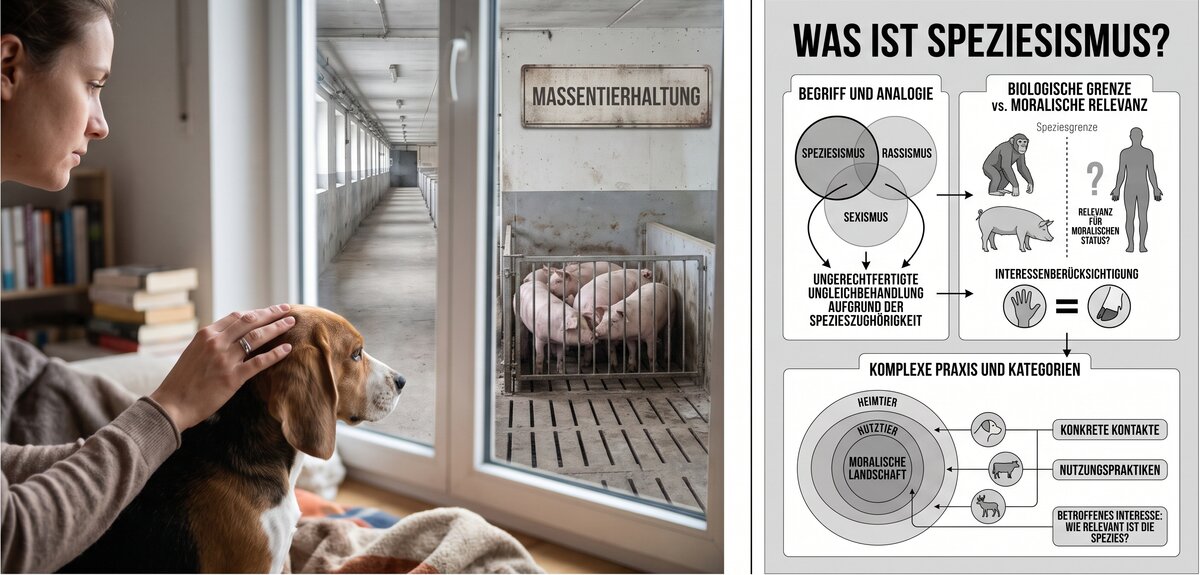
Speciesism
Speciesism is a term of moral censure. It denotes the allegedly unjustified disadvantaging of individuals on the basis of their membership in a biological species. Whether a concrete instance of unequal treatment is indeed unjustified, and therefore speciesist, cannot, however, be discerned from the name alone – this is precisely what must be examined argumentatively.
Coined by Richard Ryder and introduced into contemporary animal ethics in a decisive way by Peter Singer, the term draws a direct analogy to racism and sexism. What at first glance appears to be a clear moral verdict proves, upon closer examination, to be a highly differentiated philosophical field of inquiry.
The ethical debate revolves essentially around four central questions:
- Biological boundaries vs. moral relevance: Evolutionary biology yields historically grown populations and lines of descent, but no rigid essences. Even well-defined species boundaries do not, in themselves, establish any moral precedence of the human being (Homo sapiens).
- Unequal treatment vs. discrimination: Not every difference in treatment is unjustified. What is decisive is the relevance of the criterion to the respective interest at stake: while biological characteristics may, for instance in medicine, call for different measures, they may not justify any arbitrary disadvantage where comparable basic interests are concerned (such as the avoidance of pain and suffering).
- The web of social practices: Our actual practice seldom follows a purely biological species boundary. Categories such as pet, livestock, or wild animal divide individuals of the same biological species according to human forms of use and relationship, thereby overlaying purely biological taxonomy.
- Equal worth rather than uniformity: The principle of equal consideration of interests (equal consideration of interests) does not demand factual equality of all capacities. It expressly allows for asymmetries – for instance between capable moral agents (moral agents) and beings that merely require protection (moral patients) – yet it requires that comparable interests be accorded the same moral weight, irrespective of species.
The charge of speciesism does not furnish a complete, self-contained ethical system, but rather functions as a normative touchstone concept: it exposes arbitrariness and inconsistencies in our patterns of justification and compels us not merely to assert moral boundaries on biological grounds, but to justify them in a manner that is normatively tenable.
A peculiar standard argument in animal ethics
Speciesism
At first glance, the expression speciesism appears to be entirely transparent. A speciesist, one might think, favours members of her own species over members of other species. The very name suggests an analogy to racism and sexism: where race or sex is made the ground of an unjustified unequal treatment in those cases, biological species membership is supposed to play the same role here. Richard Ryder coined the expression around 1970; Peter Singer soon after made it a foundational concept of recent animal ethics. Yet the apparent simplicity of the concept is deceptive. For as soon as one asks what a species is, which boundary is actually being drawn in the dispute over animal ethics, and what exactly is supposed to be unjustified about an unequal treatment, the initially clear analogy dissolves into several distinct questions.
Which boundary is actually at issue here?
Species is, in the first instance, a biological concept. Species form basic units of biological classification and evolution. Yet it is by no means conclusively settled how these units are to be determined. The older notion that each species possesses an immutable essence shared by all and only its members fits poorly with evolutionary theory. Mutation, recombination, variation and gradual speciation make it unlikely that, for every species, one could specify a bundle of traits possessed by every one of its members and by no member of any other species. For this reason, species are today often understood instead as historically connected populations or evolutionary lineages. Other conceptions foreground reproductive isolation, ecological relationships or phylogenetic descent. Accordingly, the biological and philosophy-of-science discussion does not recognise a single species concept.
This does not mean that biological species are merely arbitrary inventions. Dogs and humans, chimpanzees and chickens are not distinguished for the same reason as red and green cars. Evolutionary relations of descent, population structures and reproductive relationships are real facts. But something weaker—and more interesting for ethics—follows from this: biology does not by itself supply a single, essential species boundary to which a moral boundary could simply be attached. Even where a biological species boundary is well defined, it remains entirely open what follows from it morally. Donald Graft makes this gap especially visible when he reconstructs his “strong speciesism” as the thesis that members of a species may exploit other species insofar as this is necessary for the preservation of their own. That species can be biologically distinguished evidently does not yet establish such a permission.
A further, linguistic problem arises here. Animal ethics constantly speaks of the “human–animal boundary.” Biologically, this manner of speaking is skewed. Humans do not stand opposed to animals in the way that animals stand opposed to plants. Homo sapiens is itself an animal species. What is actually meant, therefore, is the boundary between humans and non-human animals. But this boundary is not a species boundary alongside others. Between human and chimpanzee runs a boundary between two species; between human and “animal,” by contrast, a single species, Homo sapiens, is set against the totality of very many other animal species. On one side, then, stands a particular evolutionary lineage; on the other stand chimpanzees, pigs, chickens, octopuses, trout, flies and countless further species. This alone shows that the moral opposition “human – animal” does not simply map onto biological taxonomy.
This becomes even clearer when one considers the boundaries that actually structure our dealings with animals. “Livestock,” “wild animal” and “pet” do not designate species. Moreover, they do not even belong to the same kind of classification. A farm animal is defined by its use by humans; a wild animal by its way of life or its legal status; “domestic animal” can zoologically mean a domesticated animal, but in everyday usage usually refers to a companion animal kept in the household. A cow is biologically a domestic animal in the sense of a domesticated animal form, and at the same time typically a farm animal. A rabbit can live freely as a wild animal, be kept as a companion animal in the living room, as a laboratory animal, or as a farm animal. A pig of the very same biological species can be slaughtered as an agricultural farm animal or treated as an individual companion animal with a name, a veterinarian and membership in the family.
Two quite different kinds of boundary thus come apart. Species boundaries classify organisms biologically; categories of use and relationship order individuals within human practices. Both can become morally operative, but in different ways. When two pigs of the same species are treated very differently solely because one counts as a companion animal and the other as a farm animal, this is precisely not a case of unequal treatment along a species boundary. Conversely, the human/non-human boundary can, in practice, interact with such social lines of demarcation. The actual moral landscape is therefore considerably more complicated than the word “speciesism” initially suggests.
Unequal treatment is not yet discrimination
The conceptual difficulty is compounded as soon as speciesism is defined as “unjustified unequal treatment.” The word unjustified is by no means an innocuous addition. It is, rather, precisely what determines whether a moral charge is present at all.
Not every unequal treatment is unjust. This can be seen particularly clearly in the case of sexism. We rightly consider it sexist to exclude women from university study on the sole ground of their sex, or to ascribe to them, indiscriminately, lesser intellectual capacities. It does not follow from this, however, that sex can under no circumstances justify a difference in treatment. In medicine, anatomy, hormonal status, pregnancy, metabolism or sex-specific differences in disease risk can be relevant to diagnosis, therapy or dosage. Equal treatment does not, in this context, require that a woman and a man be prescribed the very same medication in the very same dosage under all circumstances. A medically appropriate treatment may itself require that they be treated differently.
Horta expresses the very same thought by means of a particularly clear example (pp. 247, 250): that only women receive gynaecological care would not be sexist merely because men do not receive this treatment. Equal consideration does not mean uniformity of treatment. It requires, rather, that differences be taken into account precisely where they are relevant to the interest concerned in each case.
This shifts the decisive question. It is not: Is there differential treatment along some boundary? But rather: Is the very difference invoked morally relevant to the treatment in question? A boundary may itself be relevant here, it may merely be a useful indicator of something else, or it may be wholly irrelevant. For a particular cancer therapy, biological sex may be relevant to a given illness; for the right to vote, it is not. A child’s age may serve as a reasonable approximation for legal capacity, without every individual seventeen-year-old thereby having to be less capable of judgement than every eighteen-year-old. Criteria can thus also serve as pragmatic proxies for properties, without themselves constituting the ultimate normative justification.
It is precisely here that Bonnie Steinbock’s critique of too hasty an analogy between sexism, racism and speciesism begins. She does not dispute that mere species membership can be morally irrelevant. What she disputes is the next step: that it therefore follows that differences between human and non-human animals are irrelevant across the board. Capacities such as rationality, moral responsibility or self-respect could be relevant to certain moral questions, even where fur, plumage or taxonomic name are not.
This does not yet prove Steinbock’s position. It notoriously comes under pressure as soon as some non-human animals possess capacities that some humans lack. Steinbock herself takes this problem seriously. If cognitive capacities are meant to explain humans’ higher moral standing, the question arises why a severely cognitively impaired human being nonetheless does not rank below a correspondingly more capable animal. At this point, Steinbock partly shifts her argument from individual properties to special obligations, dependencies and forms of identification with other human beings. This very shift is philosophically instructive: it shows that the dispute over speciesism concerns not only which properties a being possesses, but also whether relationships, memberships and shared forms of life can generate moral reasons.
“Unjustified unequal treatment” cannot, therefore, be diagnosed simply by the appearance of some biological or social boundary. One must ask, at the very least, in what the unequal treatment consists, which interest is affected, which property or relationship is supposed to justify it, and whether this property is relevant to precisely this difference. Only then can it be judged whether an unequal treatment is discriminatory.
What, then, can “speciesism” mean?
The literature becomes clearer once one stops treating every position that appears under the name of speciesism as a variant of one and the same thesis. Oscar Horta is especially helpful here. He begins with three possible definitions but explicitly declines to treat this as the discovery of three different kinds of speciesism. His preferred definition runs, roughly: speciesism is the unjustified disadvantageous consideration or treatment of individuals because they are not classified as members of one or more particular species (p. 245). For him, the adjective “unjustified” belongs to the definition itself. A justified unequal treatment is therefore, in this terminology, precisely not speciesism.
This definition has an advantage and a cost. The advantage is that “speciesism” unambiguously designates a moral defect, similar to the pejorative uses of “racism” and “sexism.” The cost is that the concept itself no longer settles which instances of unequal treatment fall under it. Anyone who has shown, by Horta’s definition, that a practice is speciesist has already shown that it is unjustified. Conversely, one cannot show a practice to be unjustified merely by calling it “speciesism.” Otherwise, the evaluative judgment that still needs to be established would be smuggled back in through the definition.
Horta therefore usefully distinguishes between speciesism itself, the ways of defending it, and speciesist positions. A disadvantage may be justified directly by species membership: humans count for more because they are human. But it may also be defended by appeal to properties allegedly possessed by all and only humans, such as rationality, language or moral responsibility. A third group of justifications appeals to relations: solidarity, community, kinship, mutual obligations or particular closeness. Finally, such criteria can be combined with one another. Horta therefore speaks of simple and combined speciesist positions, rather than of ever new forms of speciesism.
A second distinction is also helpful for the overall picture. Anthropocentrism and speciesism are not the same thing (p. 258). For Horta, anthropocentrism initially designates the factual or normative favouring of human over non-human individuals. Whether this favouring is justified is left open by the definition. Only once it cannot be justified does anthropocentrism become an instance of speciesism. This is conceptually cleaner than condemning every moral precedence of the human merely by naming it as such.
A third distinction concerns the strength of what is supposed to follow from species membership. Roger Wertheimer rightly points out that very different claims travel under the heading of “speciesism.” It is one thing to say that being human is morally relevant at all, and quite another to claim that humans may favour humans, that they even have special duties toward humans, or that only humans can be full members of the moral community. These theses do not straightforwardly imply one another. A text on speciesism should therefore always state explicitly which of these claims is being disputed.

The expression speciesism sounds like the designation of an already established moral transgression. In analogy to racism and sexism, it appears to say: human beings treat non-human animals worse on account of their species membership, even though this difference is morally irrelevant. It is precisely in this that the argumentative force of the expression lies – but also its difficulty. For the charge of speciesism does not confront a moral no-man's-land. It first confronts an already established moral world.
A morally established world. Human beings grow into a culturally shaped human-animal relationship. In a carnivorous culture, it is considered normal to breed and eat pigs, cattle, or chickens, while treating dogs or cats as companion animals and generally not regarding human beings as food. Such differences are not merely biological facts. They belong to a practised order of values, relationships, roles, and permitted or prohibited actions.
That such an order is morally established does not, however, mean that it is morally good or infallible. Slavery and the political subordination of women, too, were for a long time components of morally and legally established worlds. Even where freedom, equality, or human rights had already been proclaimed, their institutional and moral concretisations could, in fact, primarily encompass free men – often white men. Women, for example, long possessed neither active nor passive suffrage; enslaved persons, despite universally sounding claims to freedom and equality, were excluded from their full scope.
Precisely such examples reveal a peculiar characteristic of moral validity: a moral world can appear, from within, meaningful, ordered, and even just, and from another or later perspective, as grave injustice. From this it follows neither that tradition creates right, nor that existing morality is philosophically meaningless. A historically and culturally established order of values can be a source of moral validity and orientation without being its only or infallible source.
Ethics may not simply dismiss this source of validity. It is precisely here that a methodological problem of animal-ethical egalitarianism arises. Whoever stipulatively presupposes that human beings and non-human animals are of equal moral worth can immediately describe the existing inegalitarian animal morality as a deviation from an already valid principle of equality. But in doing so, an essential part of the philosophical work has already been accomplished before it has even begun.
In this, however, a peculiar asymmetry of the burden of proof threatens to emerge. The critique of speciesism rightly points out that no moral difference in rank follows, in itself, from the biological boundary between Homo sapiens and other species. A descriptive difference does not by itself generate a normative hierarchy. But the same methodological reservation also holds in the opposite direction: from the fact that the species boundary does not ground moral inequality, no moral equality of worth yet follows. The refutation of a ground for inequality of worth is not already the grounding of equality of worth. Whoever treats human beings and non-human animals as of equal moral worth, or ascribes equal weight in principle to comparable interests, thereby advances a positive normative thesis that is itself in need of justification. The charge of speciesism can therefore normatively discharge the biological boundary; but it cannot simply occupy the place thus vacated with a principle of equality.
The existing animal morality is not thereby justified. But it must first be reconstructed as what it is: a morally structured practice with its own valuations and distinctions. Only then can one ask which of these are tenable and which are not. This is not moral positivism. It is not being claimed that what is valid is therefore right or good. What is being claimed is merely that what actually possesses validity as a moral order may not be treated by an ethics as though it possessed no normative significance whatsoever.
At this point, one can be considerably more resolute politically. One can fight for animal-ethical egalitarianism, change existing institutions, and demand new rights. This is a legitimate political task. Philosophical ethics, however, has a different task: it must also examine the presuppositions of the very position for which one is politically advocating. Political partisanship and the work of ethical justification must therefore not be confused with one another.
Inequality and equality decide nothing by themselves. A second difficulty already lies in the concepts of equality and unequal treatment. Human beings can be equal in one morally decisive respect and at the same time different in other respects. Women and men, for example, possess the same political and legal status. It does not follow from this, however, that every differential treatment of women and men would be discriminatory.
In medicine in particular, factual differences can be diagnostically or therapeutically relevant. Anatomical characteristics, pregnancy, hormonal factors, or differing disease risks can necessitate different examinations and treatments. Under such conditions, identical treatment could be precisely inappropriate. Conversely, such differences may not simply be transferred to political rights, educational opportunities, or social participation.
This brings a general point into view: equality does not immediately entail equal treatment, and inequality does not immediately entail unequal treatment. What is decisive is always a further argument as to which equality or difference is relevant to the concrete moral question. Equal worth, factual similarity, and equal treatment are three different things.
Only now does the possible transgression arise. The charge of speciesism alters the traditional description of the human-animal relationship. What, within a carnivorous culture, appears as the normal differential treatment of beings assessed differently is now described as possible discrimination. The pig suffers just as the dog does; certain human beings do not possess the capacities invoked to justify humanity's special standing; mere taxonomic membership in Homo sapiens seems to offer no convincing explanation for why comparable suffering may be weighted in an entirely different manner.
This can be a strong argument. But the transgression does not already consist in the mere fact that differential treatment occurs at all. It arises only once it can be shown that the difference on which the unequal treatment is based does not justify the concrete moral distinction. Precisely for this reason, the mere observation of a human-animal difference is not yet a diagnosis of speciesism.
The charge of speciesism is an argument, not its own justification. A convincing charge of speciesism must therefore accomplish at least three things: it must determine which concrete unequal treatment is being criticised; it must show with respect to which interests, capacities, or forms of being affected the parties involved are relevantly comparable; and it must justify why the existing differences or relationships cannot sustain the differential treatment.
Only at the end of this examination can the judgement stand that a practice is speciesist. Whoever, by contrast, first establishes that the practice is speciesism and then concludes from this that it is unjustified, is using the moral term of reproach circularly. The philosophical point, therefore, does not lie in abolishing the charge of speciesism. It lies in placing it where it belongs: as a possible result of a critique of the existing moral world – not as a substitute for this critique.
The methodological point: An existing moral order is neither right simply because it exists, nor devoid of validity simply because we criticise it. Likewise, equal treatment is neither just in itself, nor is unequal treatment unjust in itself. The charge of speciesism becomes philosophically strong only once it reconstructs the existing axiology, examines its distinctions, and justifies why certain differences cannot sustain the moral distance that a practice makes of them.

Horta's definition contains an expression that is easily overlooked: speciesism is the unjustified disadvantageous consideration or treatment of individuals. The word disadvantage initially sounds descriptive, but it already performs argumentative work. For in the debate, four different relations are readily conflated: unequal treatment, worse positioning, harming, and injustice. This creates the impression that the moral finding follows almost (automatically? logically? of its own accord?) from the worse treatment of a group.
One sees immediately in the human case that this transition does not hold. That A is permitted to study and B is not constitutes unequal treatment. For B, it may simultaneously represent a real disadvantage, for instance because his professional prospects thereby deteriorate. Nevertheless, the unequal treatment may be justified, for example because B does not meet the admission requirements. Even an actual worse positioning is therefore not yet discrimination. What remains decisive is whether the reason on which the differential treatment is based can indeed bear the weight of the difference in question.
There is, in addition, a formal difficulty. Disadvantage is, by its very sense, comparison-dependent. Whoever claims that X is disadvantaged must at least specify in which respect H and relative to which comparative standard Z X fares worse. The abbreviated formula "X is disadvantaged" conceals these open positions. Precisely in the speciesism debate, they remain astonishingly often unspecified.
This becomes apparent in the standard example: "The pig is disadvantaged relative to the human being because it is slaughtered and eaten." The plausibility of this sentence conceals the fact that several comparative operations are possible here. One may first compare counterfactually and intrapersonally: how would this very pig fare if it were not slaughtered? In that case, a possible disadvantage can be determined entirely without reference to a comparison with humans. Pain in the process of killing or the loss of future possibilities of life would be disadvantages of the pig relative to an alternative possible for this pig. The argument would then, in the first instance, be a harm argument, not a speciesism argument. The analogy to racism and sexism adds nothing further to the demonstration of the disadvantage.
Matters stand differently in the case of an interspecific comparison: pigs are subjected to a treatment to which humans are not ordinarily subjected. In that case, one requires a respect in which the two cases are comparable at all. This does not require that pig lives and human lives be weighed against one another on a single overall scale. It suffices, for instance, to assume that pain, fear, or the loss of certain goods are sufficiently comparable in both kinds of beings. But it is precisely this respect of comparison that must be specified. The standard determines what is actually being compared—and whether the comparison across species is even required for the argument.
The respect H is likewise far from self-evident. In the case of slaughter, the disadvantage could, first, consist in the pain, fear, and stress of the killing process; the matter then concerns suffering-laden experiences. Second, it could consist in the loss of future possibilities of life; this requires a theory of the harm of death that must itself be established. Third, the practice could be criticized as an expression of a lower moral status. This, again, is a different claim: a violation of status need not be the same as a diminution of welfare. A being may possibly be treated wrongly without the wrongness of this treatment consisting entirely in its being worse for that being. The three arguments therefore have different presuppositions, different scopes, and different opponents.
In the case of being eaten, this difference becomes especially visible. After its death, the pig can in any case no longer experience being eaten as a suffering-laden experience. It does not follow from this that posthumous harm is conceptually excluded. Whoever wishes to understand being eaten itself as a disadvantage to the dead animal, however, requires a corresponding theory—for instance, of persisting interests, of posthumous harm, or of a violation of status independent of experience. Alternatively, the moral problem may lie in the preceding killing, in the institution of animal use, in instrumentalization, or in a normatively problematic manner of dealing with animal bodies. The word disadvantage does not decide among these possibilities.
A peculiar normativization of the comparative concept thereby becomes visible. From
Humans receive X, pigs do not receive X
it is readily inferred that
Pigs are placed in a worse position
and from this, in turn, that
Pigs are treated unjustly.
Neither of these inferences is purely conceptual. The first transition requires a shared evaluative standard: in what respect is non-X worse for the pig? The second requires a normative bridging principle: why may precisely this disadvantage not be imposed on the basis of precisely this difference?
On closer examination, several levels lie between comparison and obligation. From "Z would be better for the pig than the present state," it does not yet follow that "Z ought to obtain." And even from such an ought-to-be, a determinate ought-to-do does not follow without further ado: who ought to bring about Z, by which means, and under which competing obligations? The comparison of disadvantage is, in the first instance, evaluative; the accusation of speciesism, by contrast, is deontic. No conceptual shortcut leads from being-worse-off to wrongdoing.
To summarize: not every instance of unequal treatment is a worse positioning; not every worse positioning is a harm; not every harm is an unjustified disadvantage; and not every alleged disadvantage can even be determinately specified so long as respect and comparative standard remain open. The accusation of speciesism therefore does not gain strength merely from the fact that a group is treated worse. It must show wherein the being-worse consists, relative to which alternative or comparison group it obtains, and why precisely this worse positioning cannot be normatively justified.
This critique, however, binds itself as well. In the case of pain, fear, and other suffering-laden experiences, the relevant respect is comparatively clear; here the semantic objection to talk of disadvantage loses considerable force. Even there, however, the further question remains open as to what treatment follows from it. The problem becomes especially acute in the case of death, use, instrumentalization, and diminution of status—that is, precisely where talk of "disadvantage" is frequent even though it remains unclarified which disadvantage is supposed to consist in what, relative to whom. Whoever accuses a practice of unjustified disadvantage owes these specifications no less than whoever rejects the accusation.