

Note
Each chapter of the book begins with a pictorial introduction to the subject matter. The depictions are each briefly described, and an explanation then leads over into the chapter. On this page, you will find the chapter vignettes. They are conceived as a methodological entry point into the treatment of the respective subject matter. By means of a discussion of the depictions, a thematic and structural synopsis of the chapter is conveyed.
For legal reasons, the images can unfortunately only be provided as schematic outlines. In the service section, there is a list of illustrations that conveys search strategies enabling you to find the corresponding image material.
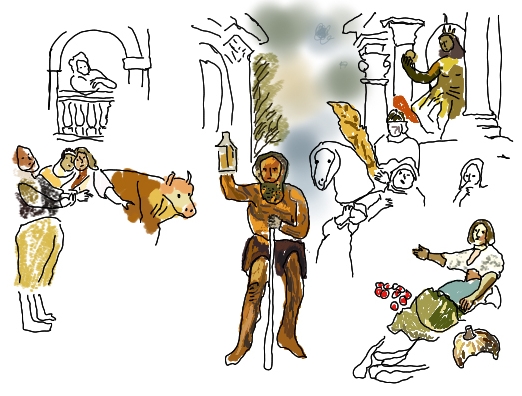
The Flemish painter Jacob Jordaens (1593-1678) places the Cynic philosopher Diogenes of Sinope (c. 391/399-323 BC) at the centre of his painting “Diogenes with the Lantern Searching for a Human Being in the Marketplace.” Threatening (or groping?), he stands there almost naked, supported by a staff. In broad daylight he stands there, holding a lantern out towards the viewer with his arm raised high. Diogenes truly did this! With the lantern, he searched the marketplace in Athens for a “real” human being among his fellow citizens. In the background, the Baroque painting affords a narrow glimpse of unadorned nature, which reaches into the crumbling architecture and thus into the realm of culture, into this scene with its lavish columns and splendid animals. Diogenes himself appears the most natural here: naked as he was born, he is marvelled at, laughed at, despised. The revelling people ponder him, yet this scene will fortunately be but a brief disturbance of their happiness. For them, it is light enough. Upon closer inspection, Diogenes’ little lamp appears rather too ridiculous!
Why do we seek happiness? Wherein does the happiness of our life consist? What significance does happiness hold in our life? How can an ethics be conducive to the realisation of happiness? – Four questions stand at the centre of this chapter. The first seems trivial. Should we perhaps seek unhappiness instead? The second seems both irrelevant and difficult at once. It is irrelevant because everyone must seek their own happiness. It is difficult because there are so many different possible answers, and one cannot realise them all at the same time. The third seems clear. Happiness is important! It is very important, which is precisely why everyone strives for it. The fourth question is presumably perplexing. How can a theory make one happy? Theoretically and practically, happiness is a core concept of ethics, one that at the same time systematically eludes it in manifold ways. For happiness may be not only an individual matter, but also a matter of fortune. Certain conceptual clarifications can shed light upon the matter of ethics and render both the unmasking provocation of Diogenes and the justified indifference of his fellow citizens equally comprehensible.

In the image we evidently find the entrance to a factory site. What is produced there? The barrier is generously open, some people are standing about (staff? visitors?). It appears to be a splendid day, as the sun warms the brick buildings to the left of the entrance road. Trees pleasantly round out the scene. Surely the work is agreeable. Only the lettering could have been designed more carefully. The “B” is reversed. Let us hope that people work more carefully on the factory premises. But the motto does make sense! Through work we become materially independent, and a productive activity can fill us with joy. Work is an important value. Well, this description of the image is grotesque. All that is missing is a reference to the brass band, absent from the picture, with which those condemned to die were “kindly” welcomed in Auschwitz. What we see in the image is an entrance. It is indeed the entrance to a factory—but one in which only death is produced industrially. Millions of prisoners were exploited in Auschwitz and then murdered in Birkenau. The motto is thus cynical, but the reversed B is a desperate (or hopeful?) sign left by the prisoner Jan Liwacz.
One gains the impression that ethics evidently did not extend as far as Auschwitz. Would it simply have sufficed for the citizens, their government, the bureaucratic apparatus, and the military to possess more morality? Can the correct ethics prevent a new “Auschwitz”? Did individuals (apart from people such as Jan Liwacz) lose the commandments of morality? Does occupying oneself with ethics make one a better person? In this chapter, we shall pursue the question of how far ethics extends. One may ask why one ought to act morally at all. Is it not better to act to one’s own advantage, or according to economic principles? In what forms can the question of justification be posed within ethics? And: what, indeed, is justification? Philosophers concern themselves with the principles of ethical and moral arguments. Do they become better human beings once they have seen through the structure of the normative and the evaluative?
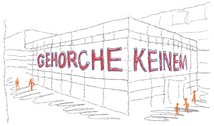
Approaching the university library in Münster, one first notices enormous, brilliant red letters. They draw us into their spell, for one wonders what might be written there upon the façade – certainly not “University Library.” One draws nearer to the glass building and begins to read “TO NO ONE.” What sense could this possibly make? One looks to the left of the building's edge for more and thus passes by the entrance. Here one reads “OBEY.” The visitor tentatively senses that this is a work of art.
Suppose that this work of art holds you spellbound as a beholder on site, through its colour, the dimensions of the letters, and the fragments of words. It compels you to draw nearer. It compels you to move back and forth in order to grasp its meaning. Once you understand it, you know that you are to obey no one. Then the work of art compels you to think further, for this is indeed a contradiction: a command that says do not obey. On the one hand, as a philosopher, you think of Kant: “Have courage to make use of your own understanding!” On the other hand, the command, in its absoluteness, is also dangerous: ought we not to obey the authority of the state? Without obedience, anarchy reigns! And surely that cannot be the meaning that cries out at us in brilliant red from a public building, can it? Whence does the work of art draw the authority to compel us to reflect upon authority? – The level of reading is secondary in this description of experience. Something already takes effect before the reading occurs, when the object overwhelms us by irritating us, arousing our curiosity, and activating us. After the reading comes reflection, which brings forth thoughts that are in themselves contradictory with respect to opposing norms. One is captivated, one acts, one reflects. In this chapter, non-cognitivism is presented as an ethics in which discursive reflection – that is, the exchange of rational arguments – is not the starting point of ethical justification.

Narcissus is a beautiful young man surrounded by darkness. He is wholly captivated by self-reflection. His attention belongs to himself alone. Nothing can penetrate his circle any longer, least of all the charm of the languishing beauty Echo. They do not become a couple. Worse still: Echo consumes herself with love. The gods had already taken speech from the nymph, allowing her only to repeat the last words spoken to her. The poor thing! And now Narcissus denies her the return of her love. The cruel man! He spurns her. She is ashamed, withdraws into a grotto, where her pain only ever increases her love. The poor thing! Of her, nothing remains but the echo. She wishes upon him that he might fall in love just as she did: never possessing the beloved! The result is plain to see. Motionless, Narcissus must gaze upon himself. Rightly so! When he kisses himself, he loses himself. Dying, he finally calls out to his beloved: “Farewell!”, and seemingly powerless, an answer comes back—one can scarcely hear it. — Echo, too, sighs: “Farewell!” At last, the three are united as lovers in this repeating response.
What, in fact, is taking place within Narcissus? Or is he merely enveloped in darkness? What does it mean to be “in love with oneself”? Is Narcissus, as one who loves (himself), an egoist? His feeling, in any case, clouds his cognition: the beloved appears to him utterly foreign. Narcissus’s motives paralyze him, destroy him. He truly seems to be in love! Rationally, this is rather incomprehensible. And what, indeed, does this Echo imagine of herself? Is it perhaps Narcissus’s egoism that consists in his unwillingness to return her love? He loves another. Yes—does she perhaps believe herself entitled to have her love reciprocated? How egoistic! Or is she, as one who loves him, merely in love with herself? The more one reflects upon it… All love, no waltz.
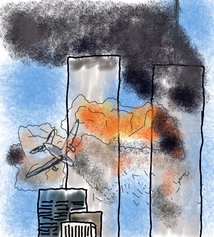
“Nine Eleven” has become a portent of modern societies. We must reckon with the possibility that terrorists may exercise unimaginable violence. On 11 September 2001, terrorists hijacked two aeroplanes and steered them, as living bombs, into the World Trade Center. The result was not only the collapse of the Twin Towers. Thousands of innocent people also died in the aeroplanes and in the skyscrapers. For days, the world lay in a state of shock. The question arose: what is to be done, should this happen again?
In Germany, the Aviation Security Act is enacted in 2005. It permits, in a comparable case, the shooting down of an aircraft by force of arms. The death of innocent passengers is accepted as a consequence, in order to prevent more people from dying through a successful attack. The Federal Constitutional Court declares this law invalid: “The authorisation of the armed forces, pursuant to Section 14 (3) of the Aviation Security Act, to shoot down, by the direct use of armed force, an aircraft that is intended to be used against the lives of human beings, is incompatible with the right to life under Article 2 (2) Sentence 1 of the Basic Law in conjunction with the guarantee of human dignity under Article 1 (1) of the Basic Law, insofar as persons on board the aircraft who are not involved in the act are thereby affected.” The dignity of the human being is indivisible, and therefore the benefit of the many cannot outweigh the life of a single person. Dignity is not something that can be weighed against other considerations. A stale aftertaste nonetheless remains: in factual terms, one also decides something when one refrains from deciding. And a weighing-up does, in fact, take place: for who can be certain that the omission arises solely from the prohibition of killing persons of equal dignity?

The two scenes illustrate a chapter of the Welscher Gast by Thomasin von Zerklaere. This didactic poem concerns proficiency, good upbringing, and virtue. Right at the outset, shame is addressed. Whoever feels shame gains distance from vices such as boastfulness, lying, and mockery. The illustrations make this clear: a man approaches a woman, and they seem to be greeting one another: “Be faithful to me.” – “I vow it.” As a sign of the promise, one sees their folded hands between them. In the second scene, the woman asks herself: “Why are they gawking at me?” The men are designated as embodiments of Lying, Fame, and Mockery. Lying says, “I have had her!”, Boastfulness says, “She is fond of me!”, and Mockery says, “Look how she looks at you!”. The shamelessness of vice is shown by the boaster’s scant clothing. But the woman appears to be immune. She does not understand what Lying, Boastfulness, and Mockery want from her. She need not feel shame, because she feels bound to her promise.
Duty and temptation are two sides of the coin of morality. Duty binds us in our actions to certain requirements. It provides us with a standard by which we are meant to orient ourselves. We seal a promise with a handshake. As a sign of such promises, it then stands between us and symbolically recalls the moral demands lying behind it. The standard may indeed be stable, but we ourselves often are not. Some of our interests tempt us to break a promise. Can that be right? Already Plato determined the task of morality to be that reason must govern desire. Why should we orient ourselves toward duty as a compelling standard for ourselves? Whence come its binding force and its claim to universal validity?

“There is a painting by Klee called Angelus Novus. It shows an angel who seems about to move away from something he is staring at. His eyes are wide open, his mouth is agape, and his wings are spread. This is how the angel of history must look. His face is turned toward the past. Where a chain of events appears before us, he sees one single catastrophe, which unceasingly piles wreckage upon wreckage and hurls it before his feet. He would like to stay, awaken the dead, and make whole what has been smashed. But a storm is blowing from Paradise; it has got caught in his wings with such violence that the angel can no longer close them. This storm irresistibly propels him into the future, to which his back is turned, while the pile of debris before him grows skyward. This storm is what we call progress.” (Walter Benjamin)
When we act, we intervene in the chain of events. In 1940, Benjamin had the storm before his eyes: a murderous war was raging. In his description of Klee's painting, there is a movement away from Paradise and toward the pile of debris. Our actions drive us stormily into ruin. The intention of progress is good, but its consequences are wreckage. The large dark eyes look back. What do they see? Progress or a paradise? The wings are pushed by the storm. Where do they drive the angel? Into a future or into ruin? In an ethics, consequences—and thus the shift in perspective between motivating intentions and observable behaviour that produces consequences—play a role. But which role? For a virtue ethics, a person's character is just as much a consequence as, for utilitarianism, a sky-high heap of shards, or, for the angel, the growing distance of the pile of debris from Paradise. So what exactly are consequences?

A woman sits like a queen atop a mountain. Approaching her requires some effort. In one hand she balances a fire staff with an apple at its centre, while with the other she embraces the evergreen laurel. Whoever reaches her attains the centre and is rewarded with the laurel. Virtue is concentrated upon this centre. Yet the people in the image seem to display little sense of purpose: some lie at the foot of the mountain, others fall back down again; some are adults, some children. The boy at the upper left seems to be stuck. Upon closer inspection one recognises snakes, toads, dragons. They stand for the dangers through which we may stumble. This can happen even shortly before reaching the goal, yet the laurel shows that the virtuous person may trust in the steadfastness and guiding function of their goal.
The image of virtue appears strange, since the symbolic language of this illustration does not allude to actions and types of action at all. It is more vivid and at the same time more abstract than the approaches to ethics presented thus far. Why do the figures fall back down the mountain? The explanatory details point to vices of every kind. The toad, for instance, stands for arrogance, but also for death. The snake, in turn, stands for malice as much as for wisdom. Such references are thus not unambiguous, and accordingly the illustration presents no verdicts of the kind we know from other ethical approaches. A virtue ethics is a different kind of ethics from the modern psychological approaches to ethics. In the sense of virtue ethics, one praises and blames the actions of persons. What they do hits upon what is fitting in a given situation. The woman on the mountain therefore represents moral excellence. What is fitting, in this regard, is not a property of the action, nor of a type of action, nor even of a situation, insofar as one considers these in isolation from one another.

Connoisseurship sees inner values. Porcellana is the name of a snail. It lives in the sea, and its shell is white—white like the gold that we call porcelain. The connoisseur's gaze of the woman in the museum surely grasps at once the inner values of the sculpture, whereas some readers of this book perhaps do not. The intense firing binds kaolin, quartz, and feldspar into porcelain. Just as Botticelli's Venus emerges from the white foam of the sea, so does white gold emerge from the kiln. Already in the Rococo, figurines of filigree beauty were produced. The motifs were different. Nevertheless, Jeff Koons, with his vividly painted sculpture, joins this tradition seamlessly.
Well, most will see something else—other values. Other values than the “real” values. Are real values hidden beneath the surface? In any case, they are not seen by everyone. The sculpture can be destroyed. Can values also be destroyed? How are the values of the surface connected to the inner values? Does one see values, or does one perceive them in some other way? One may ask whether values are objective: Do things become valuable because we see value in them, or do we regard them as valuable because they are values? What are the “inner” values of the sculpture? Or is there, in truth, only the price for the work of a renowned artist? Perhaps something is valuable only as an instrument for something and for someone? Value ethics discloses itself through a series of questions to which one holds ready answers. It provides no particular method of moral reflection, nor is it practically orienting in the sense of distinguishing good, appropriate, and right actions. Rather, values furnish a horizon in whose light we interpret ourselves, our world, and our relation to it and to ourselves.

A beautiful photograph: bright colours, fine weather, clear blue, lush green. An industrial landscape full of productivity and free of dirt. A beautiful photograph. Where was Alsum again? Industry and nature blend harmoniously. It looks a little unsettled, as in many places in the Ruhr region. Only cleaner still. A few small white clouds set the blue off all the more. Busyness, productivity, engineering skill, inventiveness, and prosperity are picturesquely embedded within the idyll. Somehow the photograph also radiates leisure, but in any case, order. – Well, it is not a photograph. Alsum is merely painted. The painting is thus hyperrealistic! Or is Alsum real? (After all, a district of Duisburg bears this name. An old fishing village.)
Are the values discerned in the image – beauty, productivity, inventiveness, leisure … – real? Are values facts? Within the image, they are facts of a fictitious reality – ideals. By contrast, the actual world generally remains deficient and thus lacking. Yet perhaps this lack can be remedied? If values are facts, then they are independent of our moral judgements, and we grasp them adequately when our judgements are true – since, as facts, they fulfil the criterion of being truth-apt. On the other hand, “to exist” may also mean that moral facts, as ideas, are hyperreal. The things we grasp with our senses would accordingly be less real than ideas. But what does it mean for ideas to be hyperreal?

A girl strolls across the street? No, she is being strolled. A vast apparatus and a great deal of accompanying personnel make her walk by operating a machine. The girl is connected to this machine by strings. She is a marionette. Sometimes small children are, in fact, marionettes who are connected to their parents in a controlling manner not by strings, but by their relationships to them. And it is not only children who are marionettes.
Were we marionettes, the strings would have to be different from those of puppets and children. We see no strings on ourselves, nor does any controlling personnel appear to be present. On the other hand, one cannot characterise the effects of social relations (command, authority, influence …) as string-pulls, for we can also act contrary to their effect. If, however, we are physically compelled to do something, we are unfree and therefore not responsible. Unfreedom in this sense is independent of freedom of the will. For the metaphor of the marionette points to other “strings” by which we might be suspended: an omniscient God, in knowing the future, also knows ours. A determined universe does not know what it is doing, yet within it all states are predetermined—including what we are doing now. Would we no longer be responsible for our actions if we, as autonomous persons, were suspended from “strings” of this kind?

We grow into our lives. This process exhibits certain regularities that can be captured in a developmental model. Lawrence Kohlberg developed a famous schema for this: we begin as asocial egoists and end up (hopefully) at the level of mutually owed respect. The social perspective leads us into community. Through morality we become fit for society. This is only possible because we attain, in the personal perspective, certain degrees of the capacity for insight.
In the modern era, ethical theories mostly understand themselves as theories of the justification of moral judgements. In doing so, it is easily overlooked that every ethics also requires a psychology of moral judgement and a pedagogy. For questions of practical orientation and moral perplexities do not seem to be merely questions of knowledge. One must live within a certain knowledge and also be able to act according to it. One may reproach Kohlberg for conceiving of moral development as a fixed schema. The path to the summit of virtue seems more varied. It is also open to criticism that, in his account, everything culminates in a Kantian-inspired ethics once the highest stage is reached. Two things are questionable here: on the one hand, biographical phases are identified with ethical positions; on the other hand, psychology seems to be taking a position within the pluralistic concert of philosophical ethics. On the other hand, an ethics today can no longer develop a moral psychology entirely out of itself. Both philosophy and psychology stand in a mutual relation to one another. Determining the relationship between them, however, proves problematic.

The structural transformation of the Ruhr region changed everything. In scarcely a hundred years, a living and working space emerged in which people from all across Europe came together as if in a cultural melting pot. Everything lay close together: work, housing, leisure. Infrastructure ran through all these spheres – it connected and it divided. Yet everything soon came to an end: in 1987, Krupp workers occupied the Rhine bridge when their plant was to be closed. Arm in arm, they rose up in indignation as a culture consecrated to its own demise. Yet their plant was closed nonetheless. All that remained was the name of their bridge.
If one wishes to understand these protests, one must not think solely of the fact that the Krupp workers were being deprived of the foundation of their material security. A part of their community likewise fell away. It was precisely this that motivated their indignation and their struggle. Solidarity is a virtue of social equality. "Down below, all miners are black!", as the saying went. Each person was potentially existentially dependent upon the other. This is what bound them together! The protests in Rheinhausen mirror this existential community above ground. For the cultural melting pot that was the Ruhr region made it necessary to establish a living community bound by shared fate. One lived in settlements that one had built together, or one lived as a Kruppian in the Krupp settlement. One had to respect one another reciprocally, regardless of where one originally came from. In their leisure time, people jointly tended their pigeons or taught rabbits to play dead. In Rheinhausen, the Kruppians also protested because the closure of the plant threatened to take from them a very pillar of this communal spirit. An entire region united in solidarity out of moral indignation. But what, precisely, is solidarity?

Folded hands, yet an oath is not a pledge of fidelity. The three men symbolise a bond of loyalty – the Rütli Oath. In this way, by means of an oath, the representatives of three cantons ally themselves against the emperor. This story is the founding myth of Switzerland. The light is central: earnestly, the men direct their gazes towards the heavens. Their hands, joined together to seal the oath, are radiant in this light. Although the scene is somewhat pathos-laden, one senses that there is a bond between the persons and that they are vigorously uniting under something held in common.
The Confederates conclude no contract; they promise one another nothing. They do, however, develop an idea of themselves through which their nation is founded. To this idea they devote themselves, they realise it, and they constantly recall it. In ethics, loyalty is an important concept, since we stand within complex loyalties. Unlike solidarity, loyalty is hierarchical: together, one is loyal towards something higher. Our life is fragmented into a series of domains that follow differing ideas. We commit ourselves to working life, to family, to associations, and to circles of friends. These are the fragments of our life to which we are bound according to differing principles. Yet they often bind us in contradictory ways: loyalty at work, for instance, may compete with loyalty towards family and friends. Frequently, it is only with effort that we manage to reconcile our loyalties. Persons must nevertheless be able to live with such contradictions and the moral deficits bound up with them.